We've all been there, haven't we? Staring at a set of blueprints, only to realize mid-build that a critical pipe clashes with a structural beam. The result? Costly delays, frustrated teams, and a mountain of rework that eats into profits and timelines. It's a scene that plays out far too often in the architecture, engineering, and construction (AEC) world. But what if there was a better way? A way to catch those clashes, iron out design kinks, and streamline the entire process before shovels even hit the ground?
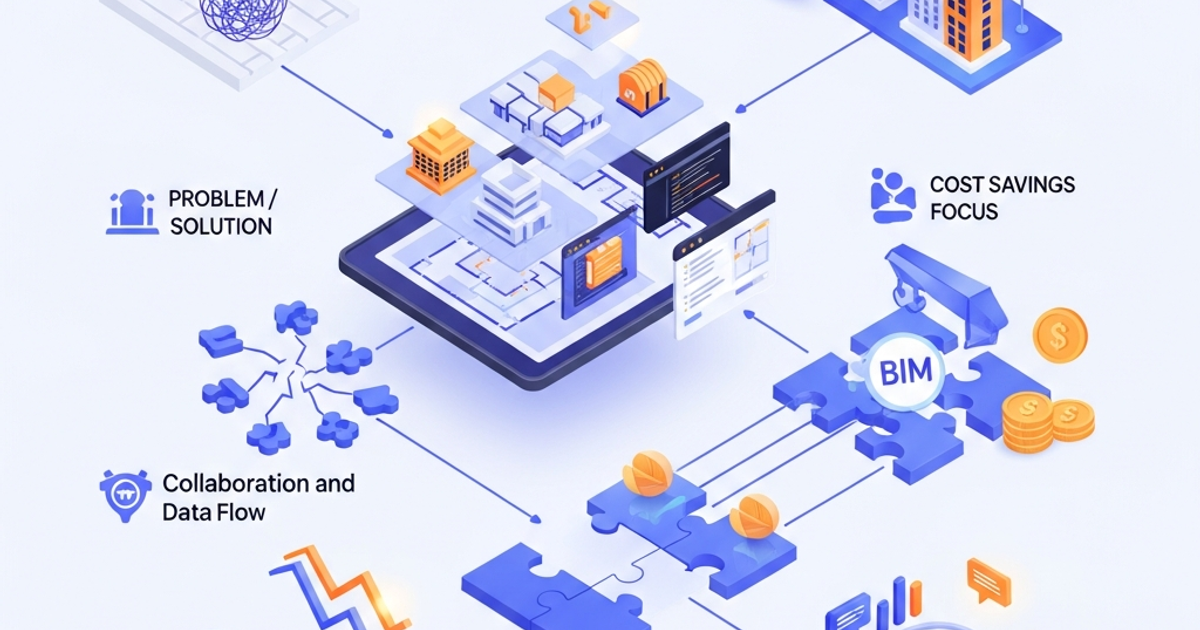
Enter Building Information Modeling, or BIM. It's more than just fancy 3D models; it's a fundamental shift in how we approach projects, offering powerful tools for reducing rework with BIM. Think of it as a digital twin of your project, a central repository of all project information, accessible and collaborative for everyone involved.
From the initial design sketches to the final handover and even into facility management, BIM transforms the traditional linear, often fragmented, process into an integrated, intelligent workflow. And the impact on reducing costly rework? It's nothing short of revolutionary.
Catching Errors Before They Cost You
One of the most significant advantages of adopting BIM is its inherent ability to detect clashes and design conflicts early on. Traditional 2D drafting often means that interdisciplinary coordination happens late in the game, usually during construction. This is precisely when discovering a ventilation shaft that collides with a plumbing line becomes a six-figure problem.
With BIM, however, we create intelligent, data-rich models. When different disciplines – architectural, structural, mechanical, electrical, and plumbing (MEP) – build their models within the same environment, sophisticated clash detection software can automatically identify these conflicts. Imagine a virtual walkthrough where the system flags every potential collision: a door that won't open because it hits a cabinet, a beam that obstructs a critical service route, or even a window that overlooks an elevator shaft. These aren't just theoretical problems; they are real-world issues that lead to expensive field modifications.
I remember working on a complex hospital project a few years back. We were using BIM extensively, and during a routine clash detection run, the software highlighted a major conflict between the HVAC ductwork and the structural steel on multiple floors. Because we caught it at the design stage, the engineering team could easily adjust the duct routing with minimal impact. Had we missed it, the excavation and re-framing required on-site would have caused a significant delay and a substantial budget overrun. That's the tangible benefit of reducing rework with BIM – proactive problem-solving.
This early detection doesn't just save money; it saves sanity. It fosters better collaboration between teams. Instead of finger-pointing when an issue arises on-site, BIM encourages a collaborative environment where architects, engineers, and contractors work together to resolve conflicts within the digital model, ensuring that what's designed is actually buildable.
You Might Also Like
- Mastering BIM Data: Your Guide to Seamless Managementin Advanced BIM Workflows
- Mastering the BIM Coordination Process: Your Key to Project Successin Advanced BIM Workflows
- MEP Coordination: The Secret Sauce of Efficient Building Projectsin Advanced BIM Workflows
Streamlining Construction with a Single Source of Truth
Beyond clash detection, BIM provides a single source of truth for all project information. This means everyone is working from the same, up-to-date set of plans and data. Think about the confusion that arises from multiple versions of drawings, outdated specifications, or information silos that plague traditional projects. BIM aims to eliminate this chaos.
Each element in a BIM model isn't just geometry; it's an object with associated data. A wall, for instance, can contain information about its material, fire rating, thermal performance, and even its cost. This rich data allows for more accurate quantity take-offs, better cost estimation, and more informed decision-making throughout the project lifecycle. When contractors have precise material lists derived directly from the model, the likelihood of ordering the wrong quantities or specifications decreases dramatically, further contributing to reducing rework with BIM.
Furthermore, 4D BIM, which integrates time (scheduling) with the 3D model, offers incredible visual clarity for construction sequencing. Project managers can simulate the construction process, identify potential scheduling conflicts, and optimize the workflow before breaking ground. This visualization helps everyone understand the project's progression, identify long-lead items, and anticipate logistical challenges. It's like having a crystal ball for your construction schedule, allowing you to steer clear of common pitfalls that lead to delays and rework.
Consider the benefits for site logistics. By visualizing the construction sequence, teams can better plan crane usage, material deliveries, and site access, minimizing on-site congestion and potential safety hazards – all factors that can indirectly lead to rework if not managed properly. The improved project planning enabled by BIM is a game-changer.
BIM for Better Facility Management
The benefits of BIM don't stop when construction is complete. The data embedded within the BIM model is invaluable for facility management and operations. Imagine handing over a project where the operations team has access to a digital model containing the exact location and specifications of every piece of equipment, every pipe, every wire, and every access panel.
This
BIM Era Engineering Team
Expert insights and analysis to keep you informed and ahead of the curve.