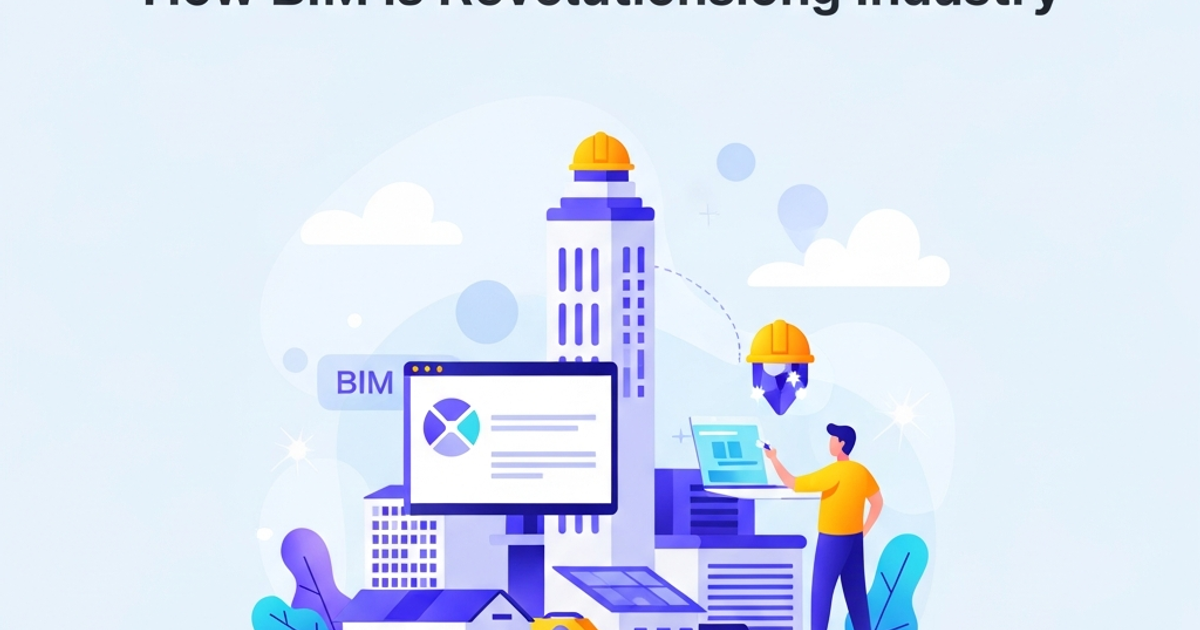
The Future of AEC: How BIM is Revolutionizing the Industry
Hey everyone, and welcome back to The BIM Blueprint! Today, we're diving deep into something that's not just a buzzword but a fundamental shift in how we design, build, and manage our world: Building Information Modeling (BIM). If you're even remotely involved in the Architecture, Engineering, and Construction (AEC) industry, you've heard the term. But what does it really mean for the future of AEC, and why should you care? Let's break it down.
For years, the AEC industry operated with a somewhat fragmented approach. Designs were handed off as 2D drawings, construction teams worked from those, and facility managers inherited a set of documents that often didn't quite reflect the reality on the ground. Think of it like a game of telephone, where crucial information gets lost or distorted along the way. This led to costly errors, rework, delays, and a general headache for everyone involved.
BIM changes all of that. At its core, BIM isn't just about 3D models. It's about creating and managing intelligent, data-rich models that represent a building or infrastructure project throughout its entire lifecycle. This digital twin allows for unprecedented collaboration, accuracy, and efficiency. It's the difference between looking at a blueprint and holding a fully interactive, information-packed model in your hands.
From Drawings to Data: The BIM Advantage
One of the most profound impacts of BIM is its ability to centralize information. Instead of scattered documents, you have a single source of truth. Imagine a project where the architect designs a wall, and that wall isn't just a line on a page. It's a digital object with embedded information about its material, structural properties, cost, thermal performance, and even its maintenance schedule. When the structural engineer reviews it, they can see all that data and ensure their steel beams integrate seamlessly. The MEP (Mechanical, Electrical, and Plumbing) team can then add their systems, knowing exactly where to place conduits without clashing with structural elements – something that used to be a major source of on-site surprises.
I remember working on a complex hospital renovation project a few years back. Before BIM, we spent countless hours trying to reconcile conflicting drawing sets from different disciplines. It was a constant battle of redlines and meetings. With BIM, we had a coordinated model. When the HVAC designers needed to run ducts, they could visually see and even digitally identify potential clashes with existing plumbing or new structural beams. This proactive clash detection saved us an estimated 15% on rework costs and shaved weeks off the construction schedule. That's a tangible benefit you can't ignore.
This integrated approach is fundamental to the future of AEC industry. It fosters a collaborative environment where every stakeholder – from the client to the contractor to the maintenance crew – can access and contribute to the project information. This transparency builds trust and significantly reduces the risk of misunderstandings and costly mistakes. The early adoption of BIM is quickly becoming a differentiator for firms looking to stay competitive.
You Might Also Like
- Unlock the ROI of BIM Implementation: More Than Just Softwarein Industry Insights
- BIM for Real Estate Developers: Build Smarter, Sell Fasterin Industry Insights
- Cloud BIM Collaboration: The Future of AEC Project Successin Digital Construction
BIM Beyond Construction: Lifecycle Management
But BIM's magic doesn't stop when the construction crew packs up. This is where things get really exciting for the long haul. The data embedded within the BIM model is invaluable for facility management and operations. Think about it: when a facility manager needs to perform maintenance on a specific HVAC unit, they can pull up the BIM model and instantly see its exact location, model number, installation date, warranty information, and even the recommended service intervals. No more hunting through dusty filing cabinets or outdated manuals!
This concept of digital twins and lifecycle data management is transforming how we operate buildings and infrastructure. It enables predictive maintenance, optimizes energy consumption, and streamlines renovations. For owners and operators, this translates directly into significant cost savings and improved building performance over the asset's lifespan. It's a shift from a linear, end-of-project handover to a continuous, data-driven lifecycle approach. This holistic view is a cornerstone of the future of AEC industry, pushing for more sustainable and efficient built environments.
We're also seeing BIM integrate with other advanced technologies. Augmented Reality (AR) and Virtual Reality (VR) allow teams to walk through a project virtually before it's built, identifying design issues early. Drones capture site data that can be integrated into the BIM model for progress tracking. Artificial intelligence (AI) is beginning to analyze BIM data for insights into cost optimization and risk assessment. This convergence of technologies is creating an even more powerful ecosystem for the AEC sector.
Key Takeaways:
- Collaboration is King: BIM breaks down silos and fosters a truly collaborative project environment.
- Data is the New Foundation: Moving beyond geometry, BIM provides rich, intelligent data that enhances decision-making.
- Lifecycle Value: The benefits of BIM extend far beyond construction into operations and maintenance.
- Technology Convergence: BIM is the central hub integrating with AR, VR, AI, and other emerging technologies.
The transition to BIM isn't without its challenges, of course. It requires investment in software, training, and a shift in company culture. But the trajectory is clear. Embracing BIM isn't just about keeping up; it's about leading the way in a rapidly evolving industry. The future of AEC industry is digital, data-driven, and incredibly exciting. Are you ready to build it?
What are your thoughts on BIM's impact? Share your experiences in the comments below!
BIM Era Engineering Team
Expert insights and analysis to keep you informed and ahead of the curve.