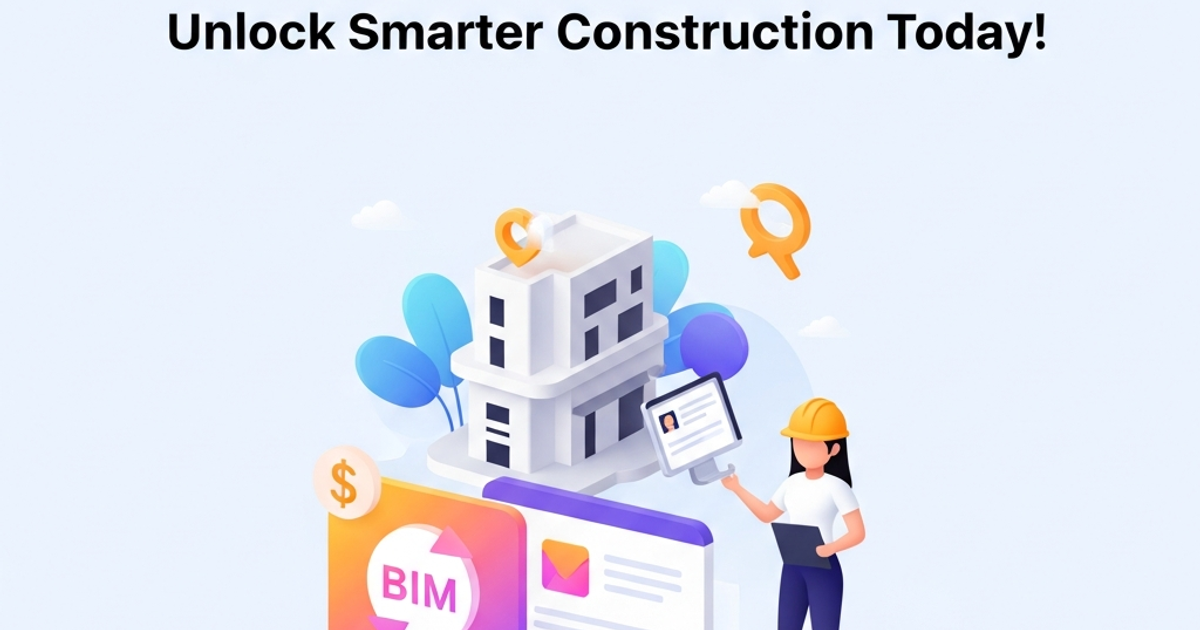
BIM for Contractors: Unlock Smarter Construction Today!
Remember the days of endless blueprint revisions, costly on-site clashes, and the general chaos that often accompanied big construction projects? If you've been in the industry for a while, you probably do. I certainly do. I recall one particular project where a minor design change in one trade threw wrenches into the schedules of three others, leading to a frantic, late-night scramble to redraw everything. It was a headache we could have all done without.
Thankfully, those days are becoming less common, thanks to a game-changer in the AEC world: Building Information Modeling, or BIM. While BIM has been talked about for years, its real impact is being felt most strongly by contractors on the ground. If you're a contractor wondering if BIM is just another tech fad or a genuine opportunity, let me tell you: it's the latter. Understanding the benefits of BIM for contractors isn't just about staying current; it's about fundamentally improving how you build, save money, and deliver exceptional results.
Bridging the Gap: From Design to Reality with BIM
At its core, BIM is more than just 3D modeling. It's a process that creates and manages information for a built asset throughout its lifecycle. For contractors, this means moving beyond flat, static drawings to a dynamic, data-rich digital model. Think of it as a virtual replica of your project before a single shovel hits the dirt.
Enhanced Visualization and Clash Detection
This is perhaps the most immediate and tangible benefit for contractors. Instead of relying solely on 2D drawings that can be misinterpreted, BIM provides an immersive 3D environment. You can literally walk through the project virtually, spotting potential issues before they become costly problems on-site. I've seen firsthand how BIM can highlight clashes between ductwork and structural beams, or plumbing lines running through electrical conduits. Identifying these conflicts in the design phase allows for resolution with a few clicks, saving you significant time and money compared to discovering them during construction. This proactive approach drastically reduces rework and unexpected delays.
Improved Estimating and Bidding
Accuracy is king when it comes to bids. BIM models are packed with data. This means quantities for materials, components, and systems can be extracted directly from the model with a high degree of accuracy. No more manual quantity take-offs that are prone to human error! This data-driven approach leads to more precise cost estimates, stronger bids, and ultimately, more profitable projects. You can present more detailed and justifiable bids, giving clients confidence in your capabilities.
Streamlined Scheduling and Logistics (4D BIM)
This is where BIM truly shines for project management. By linking the 3D model with project scheduling information (think Gantt charts), we get what's called 4D BIM. This allows you to visualize the construction sequence over time. You can simulate the project's progression, identify potential logistical challenges like site access or crane placement, and optimize the construction timeline. Imagine seeing how the building will come together week by week, understanding the dependencies between different trades, and planning your resource allocation more effectively. It makes project phasing and coordination a whole lot clearer.
Better Communication and Collaboration
Construction is a team sport. BIM fosters a collaborative environment by providing a central, shared source of truth. All stakeholders – architects, engineers, subcontractors, and owners – can access and contribute to the same model. This single source of information minimizes miscommunication and ensures everyone is working from the latest, most accurate data. Platforms that support BIM allow for real-time updates, issue tracking, and communication directly within the model, streamlining the entire workflow. Subcontractors can easily see how their work fits into the bigger picture, leading to fewer coordination errors. This collaborative spirit is crucial for a smooth project lifecycle.
Beyond the Build: Long-Term Advantages
The benefits of BIM for contractors don't stop once the building is complete. The information generated during the design and construction phases is invaluable for the operational life of the facility.
You Might Also Like
- Building Greener with BIM: Your Guide to Sustainable Constructionin Digital Construction
- Virtual Construction: The Future of Building, Today!in Digital Construction
- Cloud BIM Collaboration: The Future of AEC Project Successin Digital Construction
Accurate As-Built Information
BIM models can be updated to reflect the actual as-built conditions, creating a precise digital twin of the finished facility. This is gold for facility managers. They get detailed information on every component, system, and material used, including manufacturer data, warranties, and maintenance schedules. This makes troubleshooting, repairs, and future renovations significantly easier and more cost-effective.
Enhanced Facility Management
Imagine needing to replace a specific HVAC unit. Instead of digging through paper manuals or guessing, a facility manager can simply query the BIM model to instantly find the exact unit, its specifications, and its maintenance history. This level of detail drastically reduces downtime and operational costs. For contractors who provide facility management services or handoff comprehensive project data, this adds significant value and can lead to repeat business.
Lifecycle Cost Analysis
With detailed information on materials, systems, and performance, BIM facilitates better lifecycle cost analysis. This helps owners make informed decisions about long-term operational expenses, maintenance, and potential upgrades, which can be a selling point for contractors demonstrating a commitment to value beyond construction.
Embracing the BIM Advantage
Implementing BIM might seem daunting at first. There's a learning curve, and it requires investment in software and training. However, the long-term return on investment is undeniable. Contractors who embrace BIM are finding themselves more competitive, more efficient, and capable of delivering higher quality projects.
Reducing Risk and Improving Safety
By identifying potential hazards and improving site logistics through visualization, BIM contributes to a safer working environment. Understanding site constraints and sequences beforehand can prevent accidents related to material handling, equipment operation, or confined spaces. The proactive identification of clashes also prevents situations where workers might be exposed to unforeseen hazards during rework.
Gaining a Competitive Edge
As BIM becomes more prevalent, particularly on larger and more complex projects, demonstrating BIM proficiency is no longer optional – it’s a necessity for staying competitive. Early adopters are already reaping the rewards: winning more bids, completing projects faster, reducing waste, and building stronger client relationships. For many public and private sector clients, BIM is a mandatory requirement. Not having it means being shut out of opportunities.
Driving Innovation and Efficiency
BIM is a catalyst for process improvement. It encourages teams to think more critically about design, planning, and execution. This drive for efficiency can extend to adopting other innovative technologies, like prefabrication or modular construction, which integrate seamlessly with BIM workflows.
For contractors, the benefits of BIM for contractors are clear: improved accuracy, reduced waste, better collaboration, enhanced safety, and ultimately, a stronger bottom line. It's not just about building buildings; it's about building smarter. If you're not already exploring BIM, now is the time to start. The future of construction is digital, data-driven, and collaborative, and BIM is at its heart. Don't get left behind; start your BIM journey today and unlock a new era of construction excellence.
BIM Era Engineering Team
Expert insights and analysis to keep you informed and ahead of the curve.