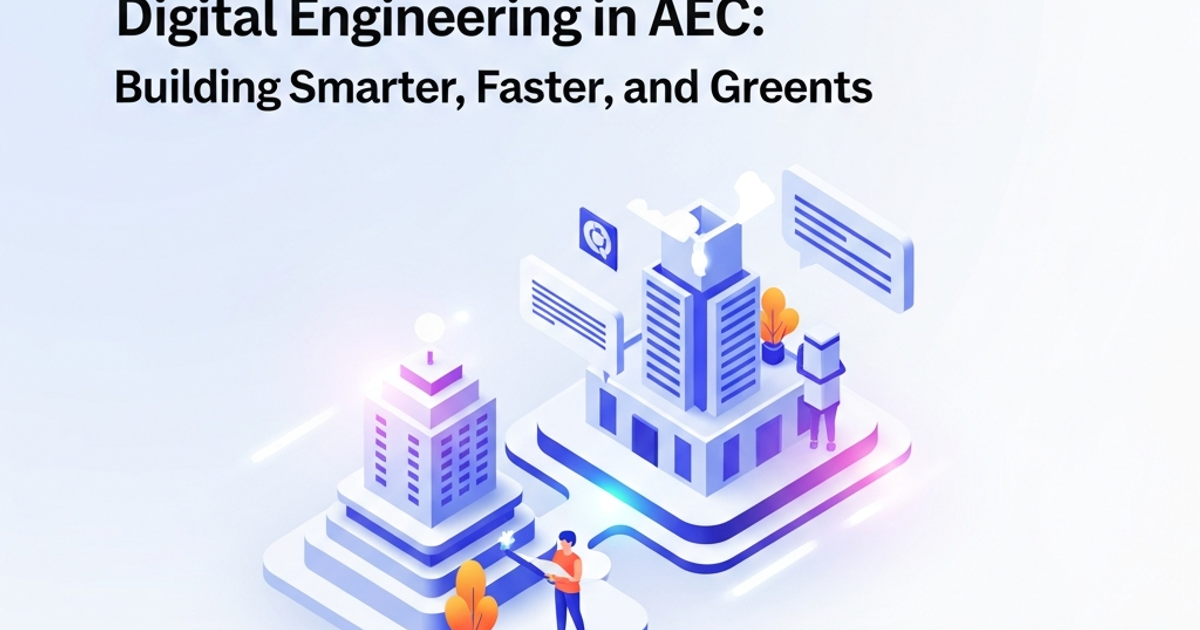
The BIM Blueprint: Your Guide to Digital Engineering in AEC
Remember the days of rummaging through endless stacks of blueprints? I do. As someone who's spent years in the trenches of the AEC (Architecture, Engineering, and Construction) world, I've witnessed firsthand the shift from paper-based plans to sophisticated digital workflows. This transformation isn't just about looking modern; it's about fundamentally changing how we design, build, and manage our built environment. At the heart of this revolution is digital engineering AEC, and a key player within it is Building Information Modeling (BIM).
Think of BIM as more than just a 3D model. It's a rich, intelligent database containing all the information about a building or infrastructure project. From the initial concept sketches to the final handover and beyond, BIM creates a connected, data-driven ecosystem. This guide will walk you through why embracing BIM is crucial for staying competitive and delivering exceptional projects.
Designing the Future: Beyond Static Drawings
Traditional design processes often involved separate teams working in silos, with information passed along via drawings. This created opportunities for misinterpretation, errors, and costly rework. BIM flips this script.
Imagine a project where the architect, structural engineer, and MEP (Mechanical, Electrical, and Plumbing) designer are all working on the same digital model. Changes made by one are instantly visible to others. If an architect moves a wall, the structural engineer can immediately see if it impacts a load-bearing element, and the MEP engineer can adjust ductwork routes to avoid new obstructions. This collaborative approach, facilitated by BIM, dramatically reduces clashes before they reach the construction site.
I remember a particularly challenging hospital project where a last-minute change to a patient room layout threatened to derail the MEP schedule. Because we were using BIM, the facilities team could visualize the impact on nurse call systems and oxygen lines in minutes, not days. We were able to re-route a few critical ducts with minimal disruption, saving us significant time and money. This level of real-time coordination is a game-changer.
Furthermore, BIM allows for advanced analysis and simulation. Need to understand how a building will perform under different environmental conditions? BIM models can be used for energy analysis, daylight simulations, and even pedestrian flow studies. This means we can optimize designs for performance, sustainability, and user experience right from the start. This proactive approach to design is a cornerstone of effective digital engineering AEC.
Building Smarter: From Model to Reality
The benefits of BIM extend far beyond the design studio. During the construction phase, a well-developed BIM model becomes an invaluable tool for planning and execution.
4D and 5D BIM: Adding Time and Cost
- 4D BIM (Time): This involves linking the 3D model elements to a project schedule. It allows us to visualize the construction sequence, identify potential logistical challenges, and optimize site layout. Seeing the project unfold virtually, day by day, week by week, helps everyone understand the plan and anticipate potential bottlenecks.
- 5D BIM (Cost): By integrating cost data with the 3D model, we can generate accurate material take-offs and cost estimates. As the design evolves, cost reports update automatically, providing real-time financial insights. This transparency is critical for budget management and making informed decisions throughout the project lifecycle.
You Might Also Like
- Virtual Construction: The Future of Building, Today!in Digital Construction
- Building Greener with BIM: Your Guide to Sustainable Constructionin Digital Construction
- BIM for Small Firms: Your Smart Path to Big Project Successin Digital Construction
Prefabrication and Offsite Construction
BIM data is essential for modern prefabrication and offsite construction. Detailed models can be used to generate shop drawings for modular components, ensuring precision and minimizing waste. Imagine fabricating bathroom pods or structural steel beams in a controlled factory environment, delivered to site ready for installation. This not only speeds up construction but also improves quality and safety. The precision enabled by BIM data makes this level of offsite manufacturing possible.
Clash Detection and Verification
Before any physical work begins, the model can be thoroughly reviewed for clashes between different building systems. Software can automatically identify where pipes might run through beams or where electrical conduits conflict with HVAC ducts. Resolving these issues digitally saves immense time and prevents costly on-site rework. This proactive clash detection is a direct benefit of implementing digital engineering AEC principles.
Managing for the Long Haul: BIM in Facility Management
Too often, the digital information generated during design and construction gets lost or becomes inaccessible once the building is occupied. BIM offers a solution by providing a comprehensive, as-built digital record that can be passed to the facility management team.
This 'digital twin' can be used for:
- Asset Management: Tracking the location, specifications, warranty information, and maintenance history of every piece of equipment, from HVAC units to light fixtures.
- Space Management: Understanding how spaces are used, optimizing occupancy, and planning for future renovations or reconfigurations.
- Maintenance Planning: Scheduling preventative maintenance based on actual equipment usage and performance data, rather than generic guidelines.
- Emergency Response: Quickly locating critical systems, shut-off valves, or emergency exits in the event of a crisis.
Imagine a facilities manager needing to replace a specific pump. Instead of searching through dusty manuals, they can pull up the BIM model, locate the exact pump model number, check its maintenance history, and even order a replacement part – all from the digital information.
This seamless handover and utilization of BIM data throughout the entire building lifecycle is what truly unlocks its value. It transforms a building from a static structure into an intelligent, manageable asset.
The Road Ahead
Embracing digital engineering AEC and BIM isn't just about adopting new software; it's about fostering a culture of collaboration, data sharing, and continuous improvement. It requires investment in training, technology, and new workflows. However, the return on investment is clear: reduced risks, improved efficiency, higher quality projects, and better-performing buildings.
For those in the AEC industry, the question is no longer if you should adopt these digital tools, but how and when. Starting with a clear strategy, focusing on specific project needs, and gradually expanding your BIM capabilities will pave the way for a more efficient, sustainable, and profitable future. The blueprint for success in modern construction is increasingly digital, and BIM is the foundation upon which it's built. This approach helps ensure better outcomes for complex construction projects.
BIM Era Engineering Team
Expert insights and analysis to keep you informed and ahead of the curve.